

What Is The Connection That Mandela Draws Between Poverty And Violence?
- May 2020
- Fast Focus Research/Policy Brief No. 48-2020
More than half dozen.v 1000000 people in the United states—well-nigh equal to the population of Massachusetts—were either incarcerated, on probation, or on parole in 2016 (Figure 1).[one] Although this number has been declining since 2009, currently about one in every 100 adults are behind bars.
The United States has the highest incarceration charge per unit, non simply of whatsoever Western democracy (Figure 2), but as well in the world. It wasn't always this style. From the 1920s until the early on 1970s, the U.Southward. rate of incarceration was stable and in line with other countries. All the same, betwixt 1973 and 2009, the rate more than quadrupled (Figure 3).
Understanding what drove the dramatic increment is complicated. The rise in imprisonment happened when crime was actually historically low, including the everyman homicide rate since the early on 1960s, so greater criminal activity is non a plausible explanation.[2]
Some studies suggest that policy changes—such as imprisoning people for a wider range of offenses and imposing longer sentences—as opposed to increases in offense contributed to the sharp increase in incarceration.[3]
This cursory explores the differences in incarceration past race, reviews related outcomes for individuals and families, and explores the challenges faced by those re-entering society after incarceration.
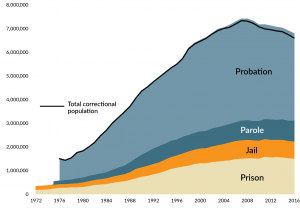
Annotation: Figure shows total correction population, including state and federal prison, local jail, and probation and parole populations, from 1972 to 2016. Individuals can accept more than than one correctional status, so the total correctional population may be less than the sum of those in each status.
Source: 1972 to 1979 data were compiled from the Sourcebook of Criminal Justice Statistics for The Growth of Incarceration in the Usa: Exploring Causes and Consequences, National Research Council Committee on Law and Justice, National University of Sciences, Apr 2014. The 1980 to 2016 data are from the Bureau of Justice Statistics, Annual Probation Survey, Annual Parole Survey, Almanac Survey of Jails, Demography of Jail Inmates, and National Prisoner Statistics Plan.
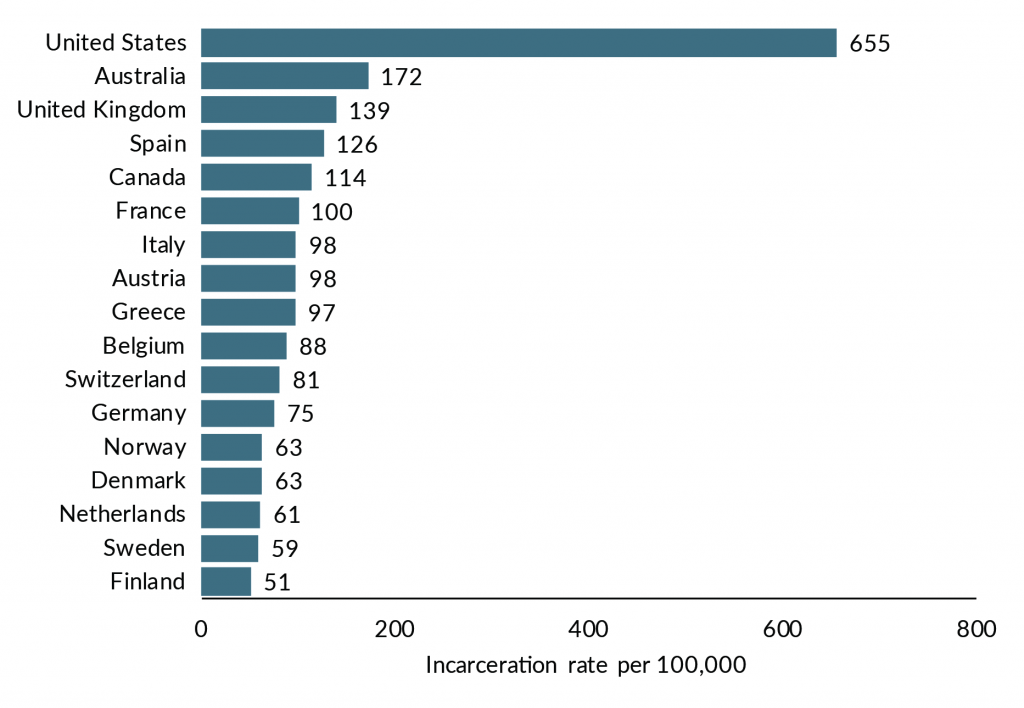
Notation: Figure shows total rates of imprisonment, including pre-trial detainees and those who accept been convicted and sentenced.
Source: R. Walmsley, World Prison Population List: 12th ed., Establish for Criminal Policy Research, University of London, 2018. Rates reported for selected System for Economic Cooperation and Development countries.
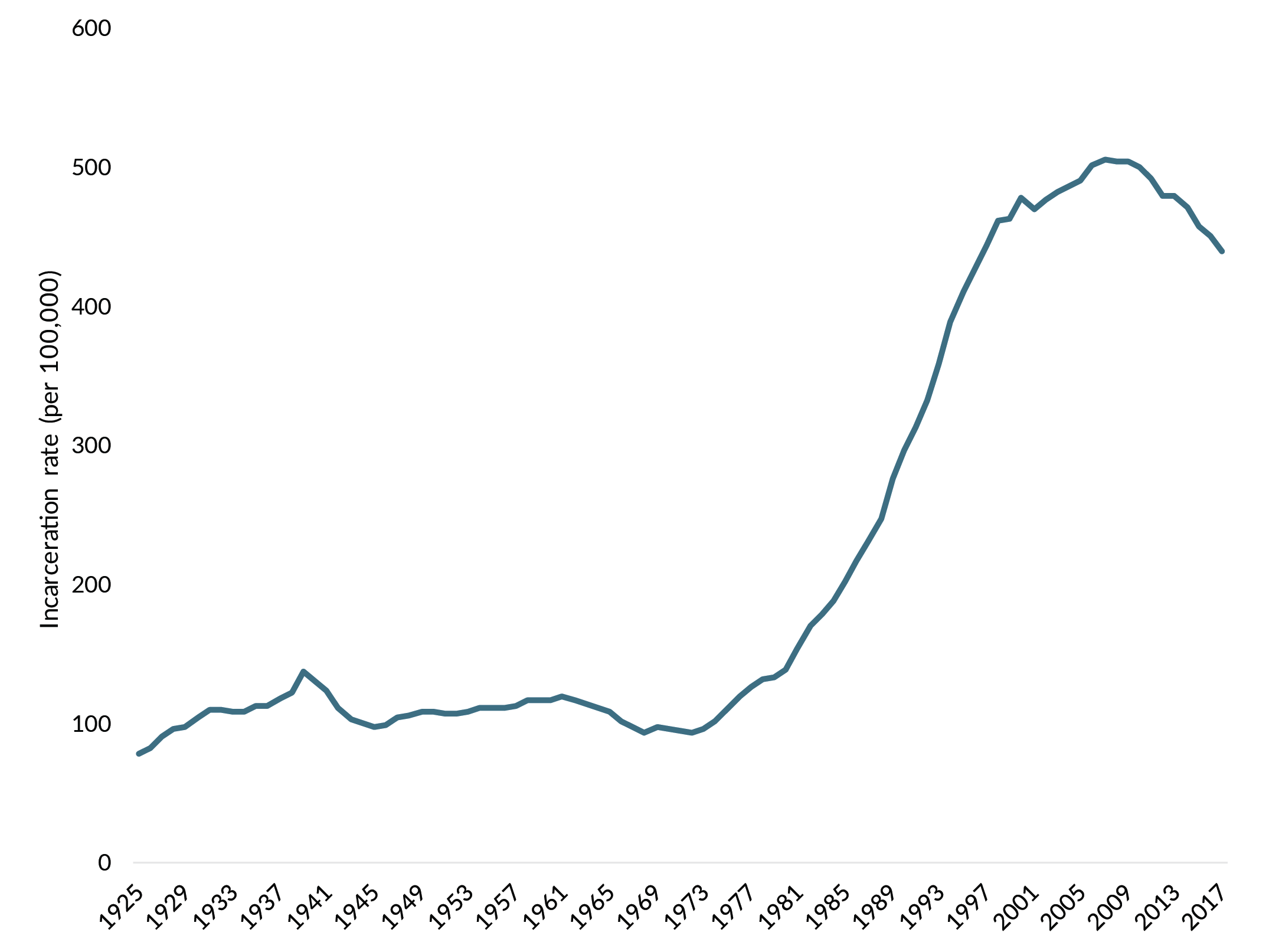
Note: Figure shows imprisonment rates for sentenced prisoners who have received a sentence of more than 1 year in country or federal prison.
Source: 1925 to 2012 data are from the Sourcebook of Criminal Justice Statistics, Tabular array 6.28.2012; 2013 to 2017 data are from the Agency of Justice Statistics, "Prisoners in 2017," Tables 3 and v.
Inequality in incarceration by race, ethnicity, and education level is extensive.
The U.S. incarceration rate is not merely high, merely it's besides highly unequal. Prison populations unduly contain African American and Hispanic men, especially men who dropped out of high school. Most of them are poor.[4]
Some researchers find links between high incarceration rates amongst men of color and policy changes that criminalized social problems experienced past many people living in poverty (who are disproportionately people of color). These challenges include homelessness, mental illness, and drug or alcohol problems. The result, these researchers suggest, perpetuates poverty and racial inequality both inside and across generations.[5]
Effigy four compares the risk of incarceration for black and white men in 1979 and 2009 by education level. While the chance increased for all groups between 1979 and 2009, the rise is particularly stark for black men who dropped out of high school. Almost 70% of the black loftier school dropouts in 2009 had been imprisoned at some betoken past age 30, which was 4-and-a-half times the rate of white loftier school dropouts.[vi]
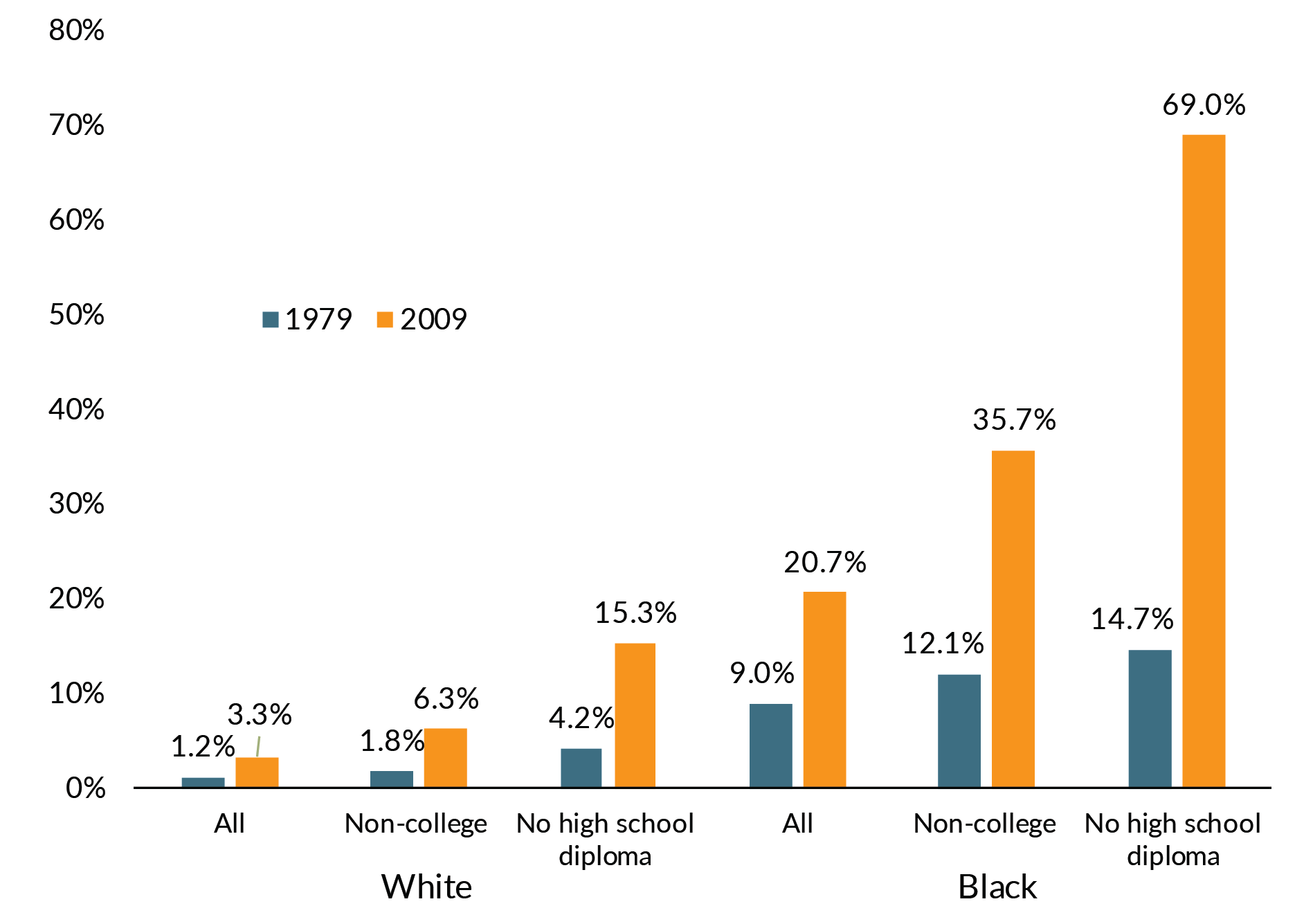
Notation: Figure shows the cumulative probability of male person incarceration past historic period thirty to 34.
Source: B. Pettit, B. Sykes, and B. Western, "Technical Study on Revised Population Estimates and NLSY79 Assay Tables for the Pew Public Rubber and Mobility Project" (Harvard University, 2009).
Information technology follows that simply every bit unequal shares of black vs. white men are imprisoned, an unequal share of black vs. white children have a parent behind bars. About i in every ix black children vs. i in every 57 white children take an incarcerated parent. Hispanic children are as well more likely to have a parent in jail or prison (ane in 28) than white children.[7]
Incarceration is associated with poorer outcomes for children and families.
High levels of incarceration are associated with many negative consequences for individuals, families, communities, and society.[8] Because people of colour are overrepresented in the prison house population, families and communities of color have been disproportionately affected by the ascension in incarceration.
Families of incarcerated men often experience economical hardship. Studies suggest that families with a father in prison are more prone to homelessness, difficulty meeting bones needs, and greater use of social assist.[ix] Financial arduousness associated with incarceration can continue after the father's release every bit ex-offenders struggle to get hired considering of their prison house record.[ten]
Children with a father in prison house are more likely to struggle with poor social, psychological, and academic outcomes than other children. These poor outcomes include depression, anxiety, and behavior problems such equally aggression and delinquency.[11] These challenges are more than common among boys and among children whose fathers were positively involved in their lives before going to prison.[12]
Less is known about whether maternal incarceration, which has grown rapidly in recent decades, affects their children. Studies to date have been based on small sample sizes. Therefore, more rigorous enquiry is needed to draw strong conclusions about the possible negative effects of having a mother in prison.
Re-entering gild after a prison sentence presents challenges.
The U.S. Section of Justice reports that over 10,000 ex-prisoners are released from country and federal prisons every week, and more than 650,000 are released every year. Studies judge that approximately two-thirds of these former inmates volition probable be rearrested within iii years of release.[thirteen]
Researchers are looking for what works to improve the transition dorsum into order and prevent the render to prison house. For instance, the Boston Reentry Study, which examined life after incarceration from the perspective of people living information technology, provides insights into the challenges faced past those returning to society.
The Boston study researchers interviewed a grouping of formerly incarcerated people over their outset twelvemonth of reentering society.[14] The following major findings emerged from the interviews:
- Interviewers institute many Boston Reentry Study participants revealed long histories of exposure to trauma in early babyhood (Effigy five).
- Interviewers plant high rates of poor physical and mental health including very high rates of substance abuse, mental disease, and chronic hurting or disease (Figure 6). The interviews suggested that many of these challenges were linked to experiences of childhood trauma and exposure to violence.
- Participants experienced a deep level of material hardship in the first year afterwards prison house. Their median income in that first year was $6,000—enough to encompass just ii-and-a-one-half months' rent for an average one-bedroom apartment.[15]
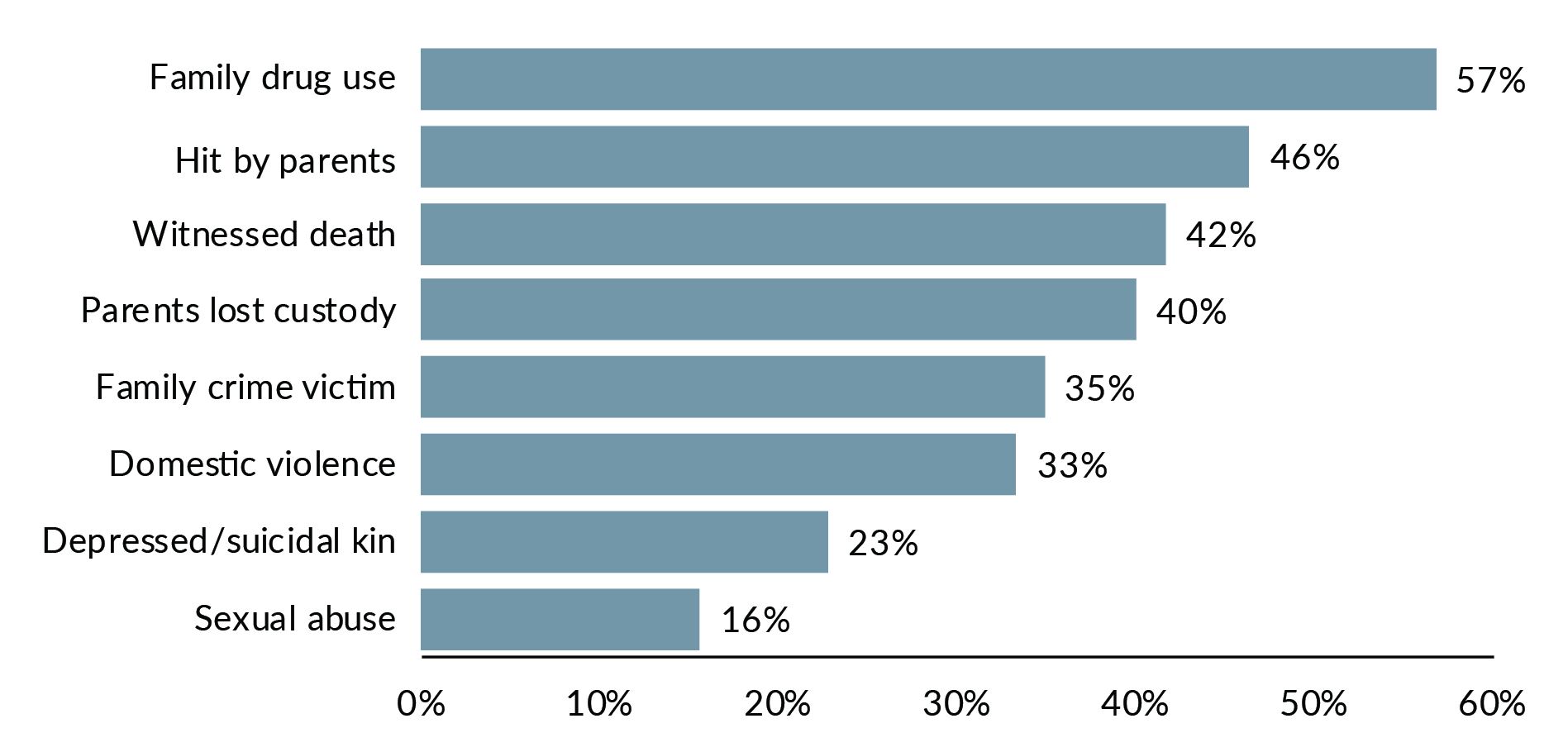
Source: B. Western, Homeward: Life in the Year After Prison house, New York, NY: Russell Sage Foundation, 2018.
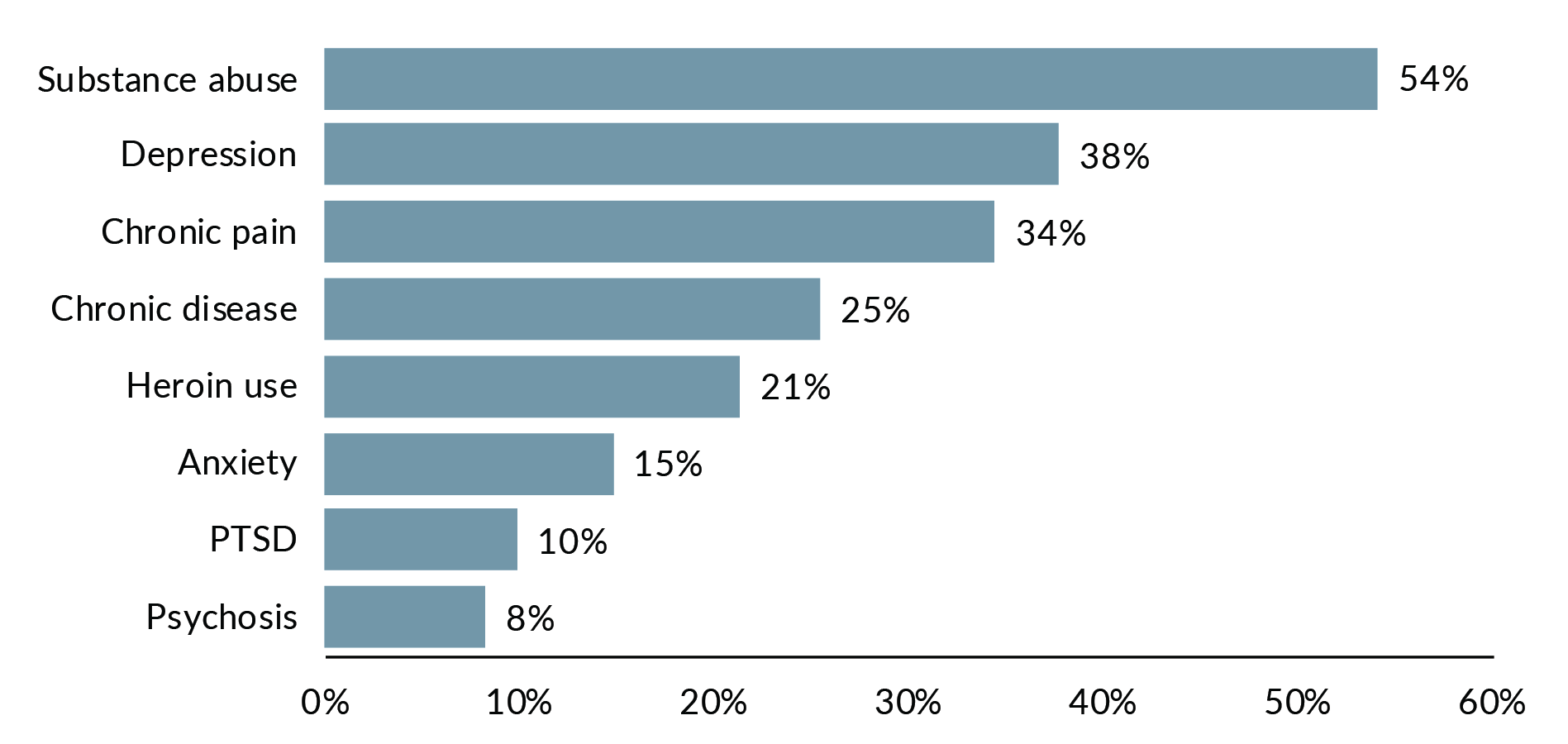
Source: B. Western, Homeward: Life in the Twelvemonth Afterwards Prison, New York, NY: Russell Sage Foundation, 2018.
Participants who reported multiple concrete or health problems were most likely to feel fabric hardship after leaving prison. Although joblessness declined over the course of the twelvemonth for most participants, those with the most serious health issues were the least likely to become employed.
Policy/Practise
Show-Based Ways to Ease Reentry and Reduce Reoffending
Researchers, practitioners, and policymakers are looking for alternatives to high incarceration and for effective ways to reduce the chances that ex-prisoners return to crime and prison house. Some examples of these efforts are explored beneath.
The Growth of Incarceration in the U.South. Consensus Committee
The National Academy of Sciences (NAS) appointed a committee of experts in criminal justice, the social sciences, and history to review research on incarceration. The commission was charged with exploring its causes and consequences, especially for families and children every bit well as former prisoners, and with developing testify-based recommendations. The resulting report, released in 2014, was entitled The Growth of Incarceration in the U.s.a..[16]
The report suggests the following practical policy steps to lower the loftier incarceration rate in the U.S.:
- Reexamine long sentences, mandatory minimum sentences, and policies on enforcement of drug laws.
- Prepare incarcerated men and women to re-enter society.
- Reduce unnecessary damage to the families and communities of the incarcerated.
U.Due south. Department of Justice on Easing Reentry

The U.S. Department of Justice (DOJ) notes that over 10,000 ex-prisoners are released from America's state and federal prisons every week, and approximately ii-thirds of them will likely exist rearrested inside 3 years of release.
The release of ex-offenders into communities represents a variety of challenges. Most often, prisoners are returning to impoverished and disenfranchised neighborhoods with few social supports and persistently high crime rates.
The DOJ identifies the following equally the 3 central elements of successful reentry into communities that benefit both ex-offenders and the community:
- Help ex-prisoners find and keep employment;
- identify transitional housing; and
- provide mentoring.[17]
Life Afterwards Prison, the Boston Reentry Report

Bruce Western, Bryce Professor of Sociology and Social Justice and Co-Director of the Justice Lab at Columbia University, suggests that neither the constabulary, nor the courts, nor the threat of penalization create public safe. Instead, establishing and maintaining bonds of customs produced by families, schools, employers, and churches and other customs organizations reduces crime and creates public condom.
Western calls for systems-level change, and cites numerous innovative programs that are helping individuals avoid prison house or transition from prison house to civilian life. Beneath are three such programs, which are highlighted in his book, Homeward: Life in the Year Later on Prison house:
- Roca, Massachusetts: A youth antiviolence program that works successfully with youths who have been involved in serious violence to disrupt the cycle of incarceration and poverty. Of the 900 immature men served in 2019, 278 were placed in jobs and 64% stayed in their job for a twelvemonth or more.
- ComALERT, Brooklyn, New York: Supports adults who are transitioning from federal, state, or city incarceration back into their community. An evaluation institute that clients were 15% less likely to be arrested again after 2 years than a control group with like criminal history who didn't participate in ComALERT.
- Transitions Clinic Network: A national network of medical clinics that provide comprehensive care for people recently released from incarceration who take chronic diseases. Each clinic employs a formerly incarcerated customs health worker on the clinical squad.
Citing research suggesting a close connection betwixt high incarceration rates and the harsh atmospheric condition of poverty in the U.Due south., Western suggests that meaningful criminal justice reform will need to business relationship for this reality, both in its policy specifics and in its underlying values.
Rethinking Reentry Report

In Rethinking Reentry[18], editor and coauthor Brent Orrell—an American Enterprise Institute resident swain who served in the U.Southward. Departments of Labor and Health and Homo Services—brings together leading academics, researchers, and criminologists to amend our agreement of what is working, and what isn't, when it comes to improving outcomes for people returning to society from prison.
The report explores new approaches to serving ex-prisoners, including:
- Providing services based on an private'due south level of risk and needs;
- Conducting more and better qualitative research to tell the story of reentry from the perspective of the returning individuals and their families, equally well equally from the police, corrections personnel, and community supervision authorities;
- Exploring the potential use of prison-based therapeutic communities in reducing a return to crime;
- Considering the role of "identity change" in preventing hereafter criminal beliefs; and
- Using best-practices in program design and implementation to restore personal agency (a sense of having power over 1's life) for reentering citizens.
Edited by Deborah Johnson
Notes
[1] U.S. Part of Justice Programs, Bureau of Justice Statistics, Correctional Populations in the United States, 2016.
[two] B. Western, "Poverty, Criminal Justice, and Social Justice," Focus 35, No. 3 (November 2019).
[3] Western, "Poverty, Criminal Justice, and Social Justice."
[4] The Growth of Incarceration in the Usa: Exploring Causes and Consequences, National Research Quango Committee on Law and Justice, National Academy of Sciences, April 2014.
[five] See "Mass Incarceration and Prison Proliferation in the United States," Focus 35, No. 3 (November 2019). See besides B. Western and B. Pettit, "Incarceration & Social Inequality," Daedulus, Summer 2010: viii–19; See also, The Growth of Incarceration in the United States: Exploring Causes and Consequences, National Research Quango Commission on Constabulary and Justice, National University of Sciences, April 2014; and B. Western, Homeward: Life in the Year After Prison (New York: Russell Sage Press, 2018).
[6] B. Pettit, B. Sykes, and B. Western, "Technical Report on Revised Population Estimates and NLSY79 Analysis Tables for the Pew Public Safety and Mobility Project" (Harvard Academy, 2009).
[vii] Having a Parent Behind Bars Costs Children, States, Pew Charitable Trusts, Stateline article, May 24, 2016.
[8] Encounter, for instance, National Inquiry Quango, "Consequences for Families," issue cursory, The Growth of Incarceration in the United States, September 2014.
[nine] National Research Council, "Consequences for Families."
[10] D. Pager, "The Mark of a Criminal Record," American Periodical of Folklore 108, No. five (2003): 937-975.
[eleven] National Research Council, "Consequences for Families."
[12] National Research Council, "Consequences for Families."
[thirteen] U.S. Department of Justice, Prisoners and Prisoner Re-Entry, north.d.
[14] B. Western, Homeward: Life in the Yr Afterward Prison house, New York, NY: Russell Sage Foundation, 2018.
[15] Estimates obtained from Renthop.
[xvi] The Growth of Incarceration in the United States.
[17] U.South. Department of Justice, Prisoners and Prisoner Re-Entry.
[18] B. Orrell, ed., "Rethinking Reentry," Washington, D.C., American Enterprise Found, January 2020..
Categories
Child Development & Well-Beingness, Children, Health, Wellness Full general, Homelessness, Housing, Housing Market, Incarceration, Inequality & Mobility, Justice System, Prisoner Reentry, Racial/Ethnic Inequality
Tags
Cantankerous-National Comparison, Disability, Qualitative Research, Race/Ethnicity, Substance Abuse (or Alcohol/Drug Abuse)

Source: https://www.irp.wisc.edu/resource/connections-among-poverty-incarceration-and-inequality/
Posted by: alonsosook1999.blogspot.com
0 Response to "What Is The Connection That Mandela Draws Between Poverty And Violence?"
Post a Comment